MXene-Based Catalysts for Sustainability Chemical Challenges
Official website of the project CA25132
The transition toward a more sustainable society requires new technological solutions in several closely connected areas, including renewable energy production, reduction of greenhouse-gas emissions, and sustainable manufacturing of essential chemicals and fertilizers. Many of these challenges depend directly on the availability of efficient catalytic materials capable of enabling processes such as hydrogen production, carbon dioxide capture and conversion, and the synthesis of nitrogen-based compounds using renewable energy sources.
MXeneCatSus addresses these challenges by focusing on MXenes, an emerging family of two-dimensional materials with highly tunable structural and chemical properties. Their large accessible surface areas, compositional flexibility, and promising performance in thermo-, electro-, and photocatalytic processes make MXenes attractive candidates for the development of next-generation catalysts based on abundant elements.
A central objective of the Action is to bring together the currently dispersed expertise available across Europe. MXene research spans many complementary disciplines, including materials synthesis and characterization, computational materials science, catalysis, theoretical chemistry and physics, and increasingly data-driven and machine-learning approaches. Connecting these communities is essential for understanding how the composition, surface chemistry, and structure of MXenes influence catalytic activity and for translating fundamental knowledge into practical materials.
MXeneCatSus therefore establishes a coordinated European research network in which experimental and computational scientists work closely together to accelerate the design, preparation, characterization, and evaluation of MXene-based catalysts. Particular attention is also given to knowledge exchange, researcher mobility, and the training of early-career scientists, helping to build long-term expertise and stronger collaborations across participating institutions.
Through this interdisciplinary approach, the Action aims to advance MXene-based catalytic technologies from fundamental understanding toward realistic applications, while strengthening links between researchers, material suppliers, technology developers, and potential end users. In the longer term, these efforts may contribute to cleaner chemical processes, more efficient use of renewable energy, and new technological solutions supporting Europe’s environmental and economic sustainability.
Key research areas: MXene materials, synthetic methods, computational materials science, catalytic conversion, and machine learning.
Participation from Serbia
Serbia participates in the MXeneCatSus COST Action as a Secondary Proposer, contributing to the development of the European research network and its activities in the field of MXene-based materials and sustainable catalysis.
Serbia is represented in the Management Committee by Prof. Sanja J. Armaković from the University of Novi Sad and Prof. Ana Savić from the University of Niš. Their participation strengthens the involvement of Serbian research institutions in the Action and supports international collaboration, knowledge exchange, and the integration of Serbian researchers into the wider European MXene research community.
Activities from Serbia
The Serbian team brings together complementary expertise in materials science, photocatalysis, analytical, atomistic modeling, machine learning, ecotoxicology, and aquatic ecology. This enables the team to follow MXene catalysts from their structure and application to their transformation, environmental behavior, and potential effects, while providing feedback for Safe-and-Sustainable-by-Design (SSbD).
1 Photocatalysis and water treatment
- Evaluation of the photocatalytic activity of MXenes and MXene-based materials in water treatment and the degradation of organic pollutants.
- Assessment of how relevant operating conditions affect process efficiency and the applicability of catalytic systems in aqueous environments.
2 Analytical monitoring of pollutant degradation
- Monitoring pollutant removal and transformation using UV-Vis and chromatographic methods.
- HPLC/LC-MS identification of transformation products and interpretation of their formation in relation to potential degradation pathways and mechanisms.
3 Adsorption and material-pollutant interactions
- Investigation of pollutant adsorption on material surfaces and the factors governing pollutant availability for catalytic transformation.
- Linking surface properties and material-pollutant interactions with observed catalytic activity.
4 Atomistic modelling and machine learning
- Atomistic modelling of material structure, adsorption interactions, and molecular reactivity to interpret experimentally observed processes.
- Integration of computational and experimental results, supported by machine learning for data analysis and the development of structure-property-activity relationships.
5 Environmental fate and ecotoxicology
- Assessment of material stability, transformation, transport, sedimentation, and bioavailability under environmentally relevant conditions, including the effects of pH, light, temperature, and natural organic matter.
- Ecotoxicological assessment across multiple levels of biological organisation, from biochemical and organism-level responses to effects on aquatic communities and ecological risk.
6 Aquatic communities and Safe-and-Sustainable-by-Design
- Community-level assessment of natural freshwater macroinvertebrate communities through changes in abundance, taxonomic composition, species dominance, functional structure, and diversity.
- Identification of sensitive and tolerant taxa and early indicators of impact, enabling environmental fate and ecotoxicological results to inform the selection and further development of safer MXene materials.
Integrated contribution of the team
From material properties to environmental safety and feedback for design
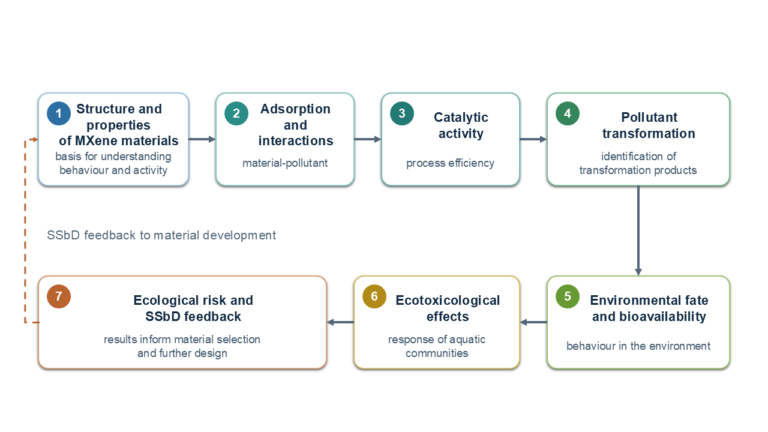
This integrated workflow evaluates catalyst performance beyond the removal of the parent pollutant by also considering the chemical identity of transformation products and the safety of the treated system. Experimental measurements, computational interpretation, and ecological assessment provide a shared basis for comparing materials and guiding their further development.
What we can offer the Action
- Joint experiments linking (photo)catalytic performance, transformation products, and ecotoxicological effects.
- STSM activities and Training Schools covering experimental, analytical, computational, and ecological approaches.
- Development of shared methodologies and protocols for environmental exposure, chemical analysis, and biological-effect assessment.
- Shared datasets, interdisciplinary publications, and stronger links between materials researchers and environmental scientists.
Contact persons and management committee members from the Republic of Serbia
Prof. Sanja J. Armaković
University of Novi Sad
sanja.armakovic@dh.uns.ac.rs
Prof. Ana Savić
University of Niš
anka@pmf.ni.ac.rs